Naschmarkt Vienna: Free To Browse, Cheap To Eat
Walking the Naschmarkt costs nothing. The Vienna Tourist Board lists it among sights with free admission, you pay only for what you buy, and on Saturdays a flea market adds a second free-to-browse layer on top.
Short answer
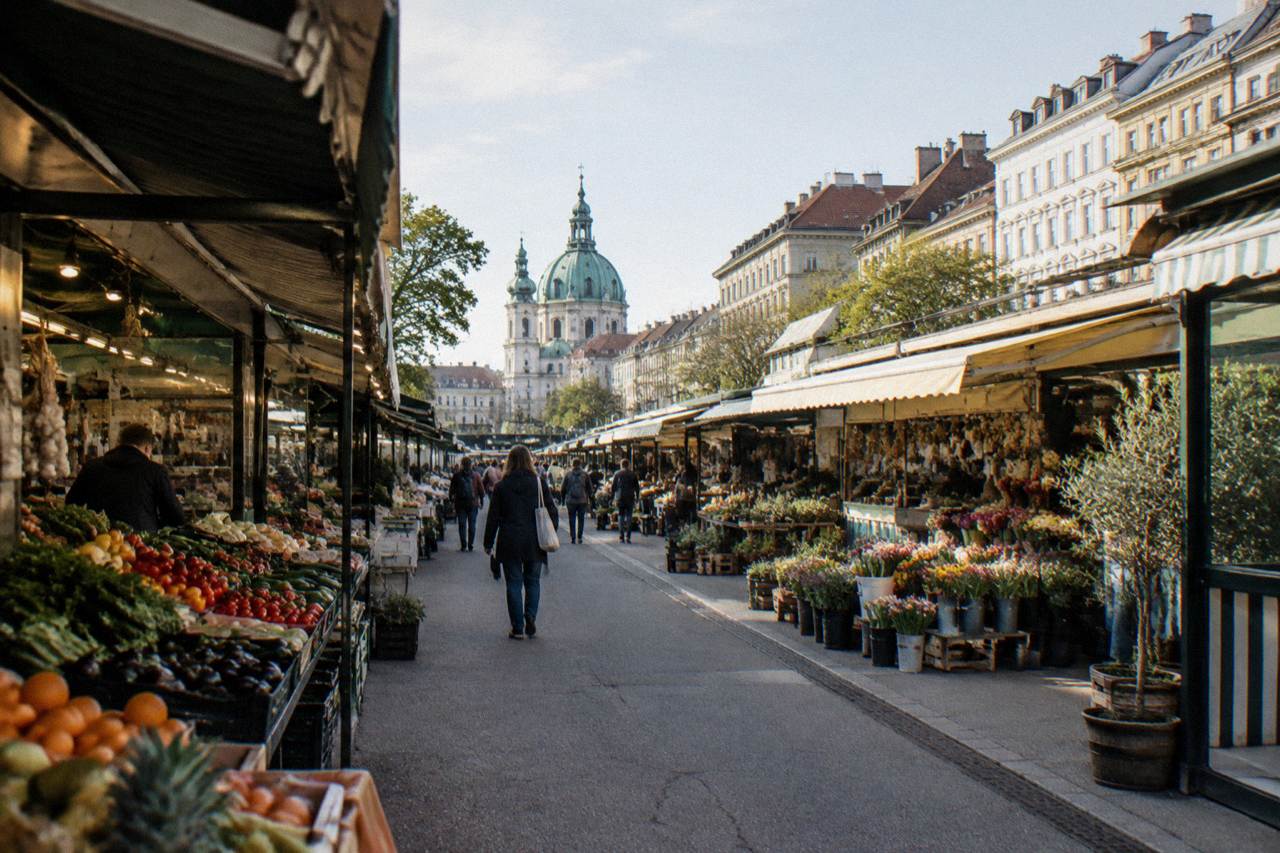
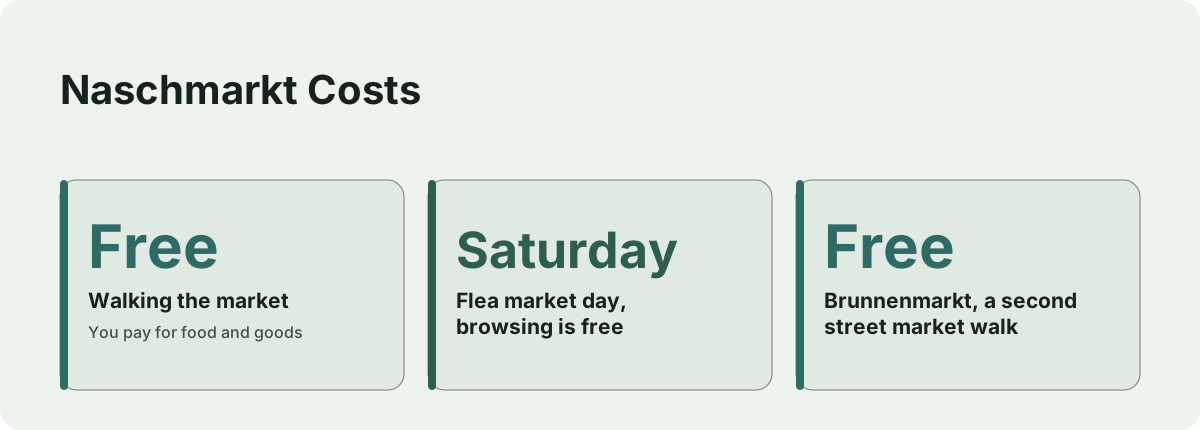
Yes, the Naschmarkt is free to walk through. Browsing the stalls costs nothing and the Vienna Tourist Board lists the market among sights with free admission. You pay only for food and goods you buy. The Saturday flea market is also free to browse. Stall hours are maximums set by the city market office, so individual stalls keep their own hours.
The Naschmarkt is the rare Vienna sight that costs nothing to see and still delivers the full experience. The City of Vienna's own market page states the deal plainly: walking the market is free, and you pay for food and goods. That makes it one of the most reliable free outings in a city where several famous names, Schönbrunn's palace, Belvedere's galleries, the Stephansdom's towers, all turn out to carry tickets once you look closely. The market does not. You can spend an afternoon there without spending a cent, and this guide from Free Things To Do In Vienna sets out exactly what is free, what is paid, and how the Saturday flea market changes the picture.
Is The Naschmarkt Free To Walk Through?
Yes, walking the Naschmarkt is completely free. The City of Vienna's market page states that walking the market costs nothing and that you pay only for food and goods, and the Vienna Tourist Board lists the Naschmarkt among sights with free admission. There is no gate, no ticket and no minimum purchase. The same rule covers the Saturday flea market, where browsing is free and only what you buy costs money.
That official status matters more than it might sound. Plenty of Vienna attractions advertise themselves as free while attaching conditions: the Schönbrunn park is free but the Gloriette terrace inside it is ticketed, the Hofburg squares are free but the Sisi Museum inside the Hofburg is EUR 20. The Naschmarkt carries no such asterisk. The city's page for the market, published at wien.gv.at/freizeit/naschmarkt, treats walking the market as the free activity and everything you buy as the paid part, which is exactly how it works in practice. If you also want a guide, Evening Highlights Walk is a free walk to pair with it.
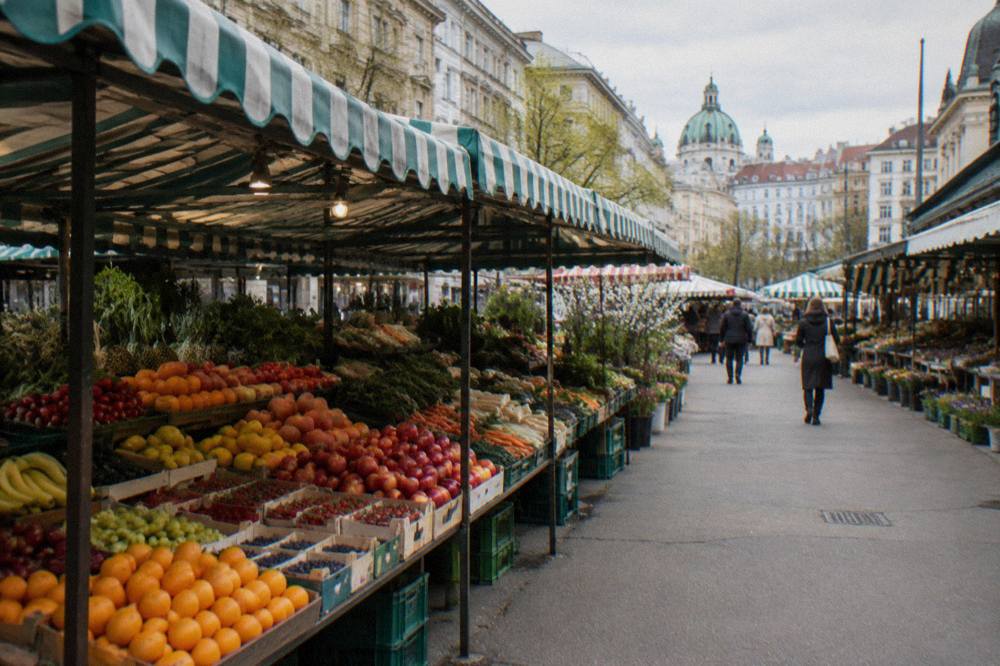
The market is also a working market, not a museum piece. Stalls sell food and goods, restaurants serve meals, and the whole thing runs on trade rather than on tourism. That has two consequences for a budget visitor. First, nobody expects you to buy anything to be there, and browsing is a normal, unremarkable thing to do. Second, the free part and the paid part sit side by side in the same aisle, so the temptation to spend is constant and the discipline of not spending is entirely yours.
For anyone building a low-cost itinerary, the market slots in naturally next to the other genuinely free city sights. The pairings that work well are listed in the table below, and the broader planning picture is covered in the guide to Vienna on a budget. If you are still at the stage of weighing the city against pricier capitals, the blog post Is Vienna Expensive? works through the numbers.
| Part of a Naschmarkt visit | Free or paid | What The Official Page Says |
|---|---|---|
| Walking the market aisles | Free | City page: walking the market is free |
| Food and goods at stalls | Paid | You pay for what you buy |
| Meals at market restaurants | Paid | Restaurant prices are set by each business |
| Saturday flea market browsing | Free | Browsing is free, purchases are paid |
| Drinking water | Free | City drinking fountains give free spring water, switched off in winter |
One practical note belongs here because it is the question people actually ask at the market: water. Vienna's drinking fountains dispense free spring water according to the City of Vienna, which makes carrying a bottle the single easiest way to keep a market visit at zero cost. The fountains are switched off in winter to prevent freezing, so in the cold months the free-water trick pauses.
What Can You Eat Cheaply There?
No official price list exists for the market's food. Eating at the Naschmarkt is a paid activity, prices are set by each stall and restaurant individually, and any figure you read anywhere should be treated as a snapshot rather than a rule. What is verifiable is the structure: browsing is free, food is paid, and the market spans everything from quick stall snacks to full restaurant meals.
The absence of a published price list is not an evasion, it is the actual situation. The city's market office sets the maximum hours stalls may trade, not their prices, and no official page lists what a snack or a plate costs. So the useful question is not "how much is lunch" but "how does the market's cost structure work", and the answer is that it works like any market: each stallholder prices their own goods, and the range is wide because the stalls themselves are wildly different businesses, from produce sellers to sit-down kitchens.
That range is the reason the Naschmarkt has its reputation for cheap eating. A market with dozens of competing food sellers in one aisle gives a visitor something a restaurant street cannot: the ability to see a dozen price levels in a two-minute walk and pick one. The decision is yours, the comparison is free, and walking away from a price you do not like costs nothing. Treat any specific price you encounter as a fact about one stall on one day, not about the market.
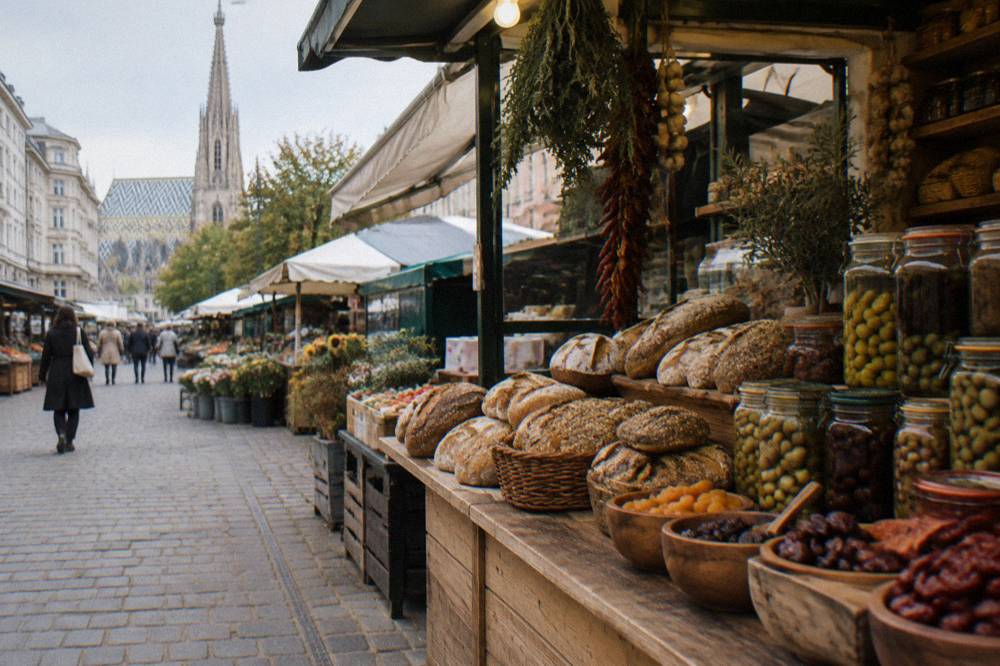
There is a free eating-adjacent activity worth naming, and one honest comparison worth making. The free activity is sampling the market as a spectacle: the displays, the trade, the rhythm of a working Vienna institution cost nothing to watch. The comparison is the Brunnenmarkt, which the City of Vienna describes as Vienna's largest street market and which carries exactly the same free-to-walk rule, as its official page at wien.gv.at confirms. If the Naschmarkt is the polished showcase, the Brunnenmarkt is the bigger, more local sibling, and browsing both costs the same: nothing.
| Way to eat at the market | What it costs | Who it suits |
|---|---|---|
| Browse only, buy nothing | Free | Anyone; the market is free to walk per the city page |
| Buy from a stall and eat standing | Paid, stall's own price | Visitors who want the lowest-commitment bite |
| Sit down at a market restaurant | Paid, restaurant's own price | Longer meals, groups, bad weather |
| Carry water from a city fountain | Free | Anyone in the fountain season; fountains are off in winter |
| Repeat the trick at Brunnenmarkt | Free to browse | Visitors who want a second, larger market |
For context on how food prices fit the wider city budget, the question gets a full treatment elsewhere on this site. The short version: markets are where the pay-what-you-choose structure of Vienna street food is most visible, and the free walking infrastructure elsewhere in the city, described in the free walking tours guide, follows the same logic of a free core with optional payment.
When Is It Open?
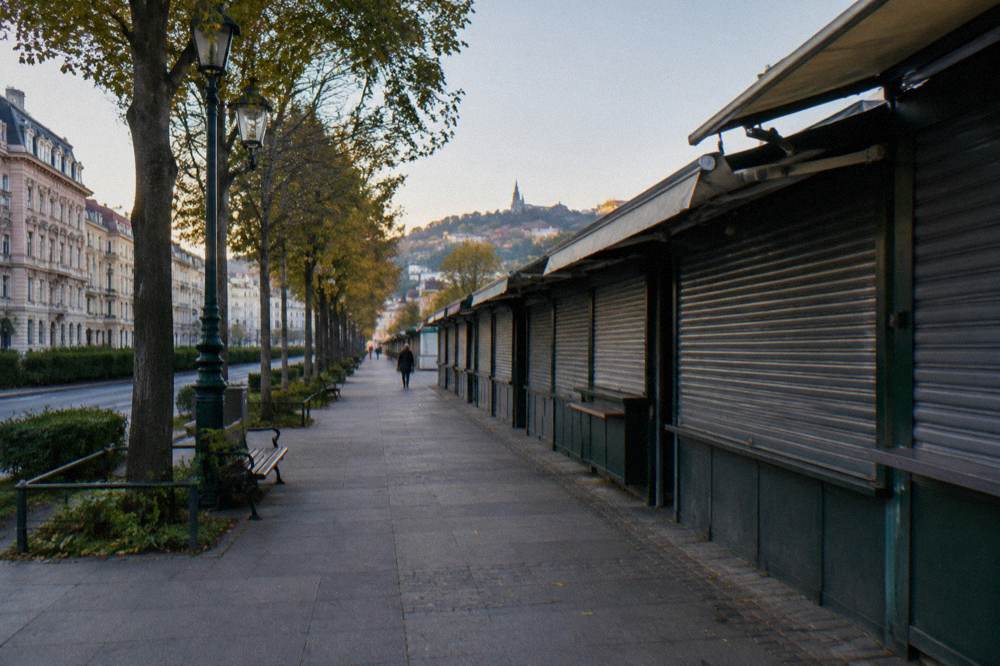
The market has no single published opening timetable, because stall hours are maximums set by the city market office and each stall keeps its own hours within them. What is fixed and verifiable: the flea market runs on Saturdays only, the market's browsing is free whenever stalls are trading, and the nearby cultural sites each publish their own hours independently of the market.
The city's market page establishes that stall hours are maximums set by the market office. It does not print a unified opening hour for the whole market, because no such hour exists in the way it does for a museum. A market is a collection of independent businesses, and the practical consequence is that the market experience varies by stall: some open early, some close early, and the aisle as a whole breathes in and out across the day.
The Saturday flea market is the one hard scheduling fact, and it is verified on the city's own page for the Flohmarkt: browsing is free, and it happens on Saturdays. If your entire plan depends on the flea market, plan for Saturday. If your plan is just the food market, any trading day works, with the caveat above that individual stalls set their own clocks.
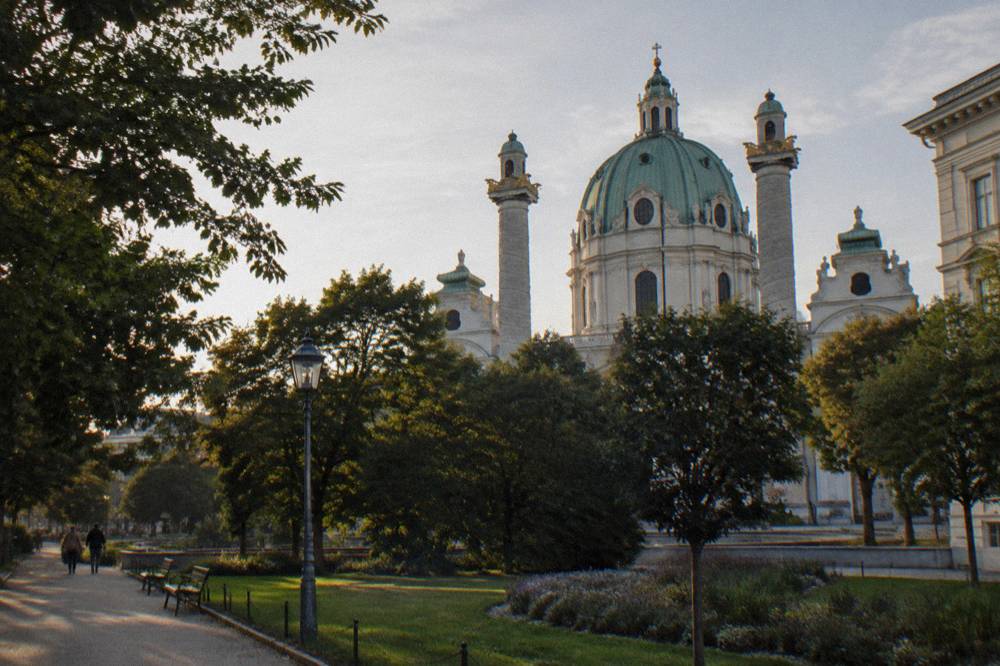
The market's neighbourhood adds its own schedule of free and paid hours, and mixing them is the standard way to build a full day here. The Resselpark beside the Karlskirche is a public park with no entry charge. The Wien Museum's permanent exhibition at Karlsplatz is free for everyone every day. The Otto Wagner Pavillon at Karlsplatz is a paid Wien Museum site at EUR 6 regular, EUR 5 reduced, free for under-19s and free for everyone on the first Sunday of the month. The Karlskirche itself charges EUR 9.50 for its sightseeing visit, with children aged ten and under free, and its two official pages give different Sunday visiting hours.
| What | When | Cost rule |
|---|---|---|
| Market stalls | Hours are maximums set by the city market office; each stall keeps its own | Browsing free, goods paid |
| Saturday flea market | Saturday only | Browsing free, purchases paid |
| Resselpark | Public park | Free |
| Wien Museum permanent exhibition, Karlsplatz | Museum opening hours | Free for everyone |
| Otto Wagner Pavillon Karlsplatz | Wien Museum site hours | EUR 6 / EUR 5; free under-19; free first Sunday |
| Karlskirche sightseeing | Own visiting hours; Sunday start time contested between its own pages | EUR 9.50; children up to 10 free |
A market morning also pairs naturally with an afternoon walk, and Vienna's free walking tours are the cheapest way to fill one. Twelve free walking tours run in Vienna, listed on GuruWalk and freetour.com, every one free with a pay-what-you-want model: you reserve a free spot and pay the guide what you think the walk was worth at the end. Three of the strongest for a market day are below.
The Historical Spots Walk with guide Jan is rated 4.93 out of 5 across 60 English-language GuruWalk reviews, a small pool but a remarkably consistent one. The Part 1 Highlights walk by redandwhite.tours is the city's biggest free tour by review count, rated 4.73 out of 5 across 6,036 English-language GuruWalk reviews. Guide Mirko's 2 Hours 15 Minutes walk is rated 4.94 out of 5 across 3,250 English-language GuruWalk reviews, the highest figure among the large-pool walks. All three are listed on GuruWalk, and all three meet in the historic centre, a short U-Bahn ride from the market.
Which Days Are Best?
No official source ranks the market's days by crowds. The days do differ in what they add: Saturday adds the flea market, the first Sunday of each month frees every Wien Museum site, the first Wednesday frees the Secession, and the last Sunday frees the Kunsthalle Wien. Picking a day is really picking which of those extras you want.
The honest framing matters here. Crowd patterns, quiet hours and "the best day to visit" are exactly the kind of plausible-sounding advice that no official page verifies, and repeating them would just be folklore with a confident tone. Several of Vienna's best-known institutions run monthly free windows, and they fall on different days.
The Wien Museum scheme is the biggest. On the first Sunday of every month, all Wien Museum sites are free, permanent and special exhibitions alike, and the Wien Museum's own page lists the covered sites: Karlsplatz, Hermesvilla, Römermuseum, Pratermuseum, Uhrenmuseum, the Beethoven Museum, the Haydnhaus and more. By the calendar rule, the coming dates are 4 October, 1 November and 6 December 2026. Since the Wien Museum's main site sits at Karlsplatz, at the market's own end of the district, a first-Sunday market morning plus a free museum afternoon is the single best-value day this neighbourhood can offer.
The other schemes sit on different days, which is worth knowing before you fix a date. The Secession, home of the Beethoven Frieze, is free on the first Wednesday of each month; its official page lists 7 October, 4 November and 2 December 2026. The Kunsthalle Wien is free on the last Sunday of each month, sponsored by the Dorotheum, and runs a pay-what-you-can window on Thursday evenings. These are three different museums on three different days, and none of them transfers: the Wien Museum's first-Sunday rule covers Wien Museum sites only, not federal museums like the KHM or the Albertina. If you also want a guide, Meet The Locals Walk is a free walk to pair with it.
| Day | What it adds near the market | Cost |
|---|---|---|
| Saturday | The Naschmarkt flea market, browsing free | Free to browse |
| First Sunday of the month | All Wien Museum sites free, including Karlsplatz | Free |
| First Wednesday of the month | Secession free, Beethoven Frieze included | Free |
| Last Sunday of the month | Kunsthalle Wien free | Free |
| Thursday evening | Kunsthalle Wien pay-what-you-can, 17:00 to 20:00 | You choose |
| Any trading day | The market itself, browsing free | Free |
One caution that belongs in any day-planning section: the under-19 free rules vary museum by museum and must never be treated as one national rule. The federal museums, the Albertina, the MAK, the Belvedere and the mumok each state free entry under 19 on their own pages. The Leopold Museum is the famous exception, charging youths under 19 EUR 2.50, and Kunst Haus Wien charges EUR 7 up to 18. If you are planning with teenagers, check each museum's own rule rather than assuming. If you also want a guide, Top Sights, Multilingual Guide is a free walk to pair with it.
If a market day leaves you wanting structure and a local's angle, a free guided walk is the natural add-on, and the one that fits this neighbourhood's history best can be reserved directly.
What Is The Saturday Flea Market?
The Saturday flea market, the Flohmarkt, is a second market layered onto the Naschmarkt on Saturdays only, and browsing it is free. The City of Vienna's page for it states the rule directly: browsing is free, purchases at stalls are paid. It is the one day of the week when the site doubles up, a food market plus a second-hand market in the same place.
The flea market is the answer to the most common scheduling question about the Naschmarkt, and the city's own page, at wien.gv.at/freizeit/flohmarkt-naschmarkt, is the source for both halves of the rule. Saturday is the day. Browsing costs nothing. Everything else is between you and the stallholder.
What that means practically is that Saturday is the day the site earns its "free to browse, cheap to eat" reputation twice over. The food market runs as it does all week, and the flea market adds a layer where the free activity, looking, is arguably the whole point. Second-hand markets reward browsers disproportionately: the pleasure is in the looking, the finds are optional, and nobody at a flea stall expects every visitor to buy. It is the closest thing Vienna has to a free spectator sport with shopping attached.
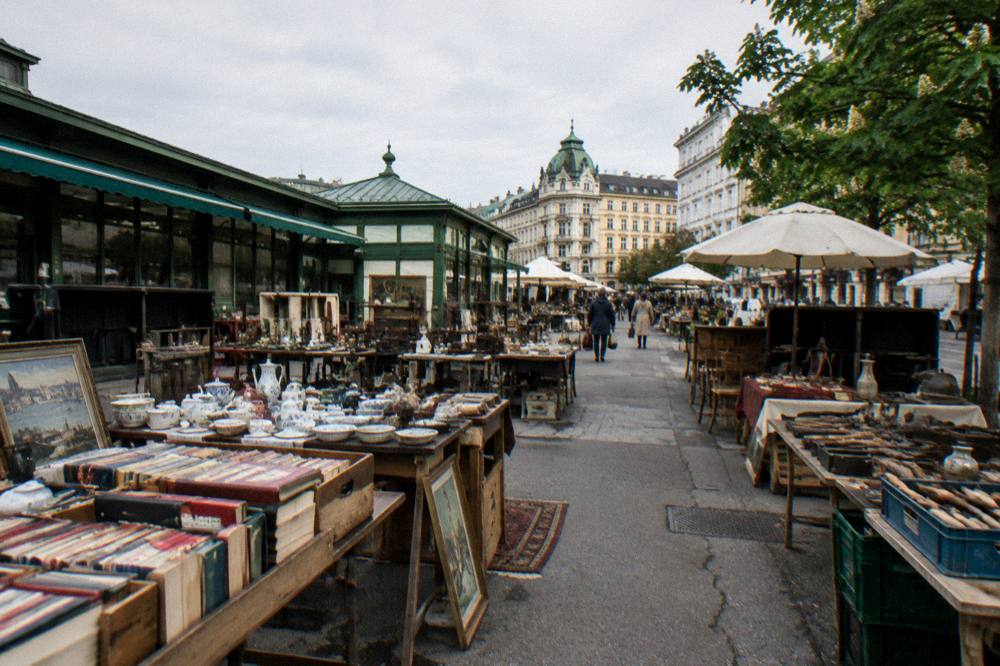
The comparison with the weekly market is worth making plainly, because the two serve different plans. The food market is a daily constant: free to walk, paid to eat, with hours set stall by stall. The flea market is a weekly event: one day, free to browse, built for slow looking rather than lunch. A visitor with one Saturday should do both in one visit, since they share the site. A visitor with no Saturday still gets the full food market and loses only the flea layer.
| Weekly food market | Saturday flea market | |
|---|---|---|
| Days | Trading days, stall by stall | Saturday only |
| Browsing | Free | Free |
| What is paid | Food and goods at stalls | Purchases at stalls |
| Best for | Eating, food shopping, atmosphere | Second-hand browsing, finds |
| Source | City market page | City flea market page |
For visitors who enjoy this kind of free browsing, Vienna has a second large example in the Brunnenmarkt, the city's largest street market under the same free-to-walk rule, and the Donaukanal street art walk, where the canal-side walls are public and the city-backed legal walls are marked with a Viennese dove. Both are covered in the site's wider free-things listings.
Which Free Walk Passes By?
No free walking tour on this site lists the Naschmarkt among its stops, so the honest answer is: none passes through it. What the verified stop lists do show is a set of centre-focused walks that pair well with a market day, meeting at points a short U-Bahn ride away: the Historical Spots Walk from the Albertina, Good Vienna Tours from Albertinaplatz, and the classic highlights walks from the Staatsoper and Minoritenplatz. A free walk worth pairing with this: 2 Hours 15 Minutes, Guide Mirko.
That answer is deliberately literal, because "passes by" is exactly the kind of claim that gets invented. The stop lists published with each walk are the only authority on what a walk covers, and none of the twelve free walking tours shipped on this site names the Naschmarkt as a stop. The market is a short hop from the centre, but a short hop is not a stop, and pretending otherwise would send you to the wrong meeting point expecting a route the guide never promised.
The strongest pairing for a market day is the Historical Spots Walk with guide Jan, rated 4.93 out of 5 across 60 English-language GuruWalk reviews. It meets at the Albertina and its published stops are Josefsplatz, the Hofburg and Heldenplatz, the Volksgarten, Minoritenplatz and the Freyung, a compact circuit of the old centre's squares and gardens. It runs about two hours in English, it is listed on GuruWalk, and its small but consistent review pool makes it a quieter alternative to the big-name walks.
The largest-pool alternative is Good Vienna Tours, the Classic Highlights walk, rated 4.9 out of 5 across 5,854 English-language GuruWalk reviews. It meets at Albertinaplatz and its published stops include the Vienna Operahouse, the Austrian National Library, the Schweizerhof, Heldenplatz, the Sisi Museum, Michaelerplatz, the plague column and the Stephansdom. It runs about two hours in English and German, and it is the walk for a visitor who wants the imperial centre explained rather than just shown. A free walk worth pairing with this: Good Vienna Tours, Classic Highlights.
| Walk | Platform | Rating and scale | Meets at | Languages |
|---|---|---|---|---|
| Historical Spots Walk, Guide Jan | GuruWalk | 4.93 out of 5 across 60 reviews | Albertina | English |
| Good Vienna Tours, Classic Highlights | GuruWalk | 4.9 out of 5 across 5,854 reviews | Albertinaplatz | English and German |
| Part 1 Highlights, Redandwhite Tours | GuruWalk | 4.73 out of 5 across 6,036 reviews | Wiener Staatsoper | English and German |
| 2 Hours 15 Minutes, Guide Mirko | GuruWalk | 4.94 out of 5 across 3,250 reviews | Minoritenplatz | English |
Beyond those, three more cardable walks round out a market-week plan. The Meet the Locals walk by Absolute Vienna Tours, rated 4.56 out of 5 across 2,189 English-language GuruWalk reviews, meets at Albertinaplatz and its stops include the Wiener Opernhaus, the Hofburg, the Stephansdom and the Spanish Riding School. The Top Sights walk by Prime Tours, rated 4.47 out of 5 across 1,309 English-language GuruWalk reviews and offered in English, German, Spanish and Italian, covers the Staatsoper, the Albertina, the Burggarten and the Heldenplatz among its stops. And the Jewish Traces walk by redandwhite.tours, rated 4.88 out of 5 across 2,513 English-language GuruWalk reviews, meets at Hoher Markt and follows the city's Jewish history through the Judengasse, Seitenstettengasse and the Judenplatz Holocaust Memorial. All three are below.
Common Questions About The Naschmarkt
Is The Naschmarkt Free To Walk Through?
Yes. The City of Vienna's market page states that walking the market is free and that you pay for food and goods, and the Vienna Tourist Board lists the Naschmarkt among sights with free admission. There is no entry charge and no obligation to buy.
When Is The Naschmarkt Open?
There is no single published timetable, because stall hours are maximums set by the city market office and each stall keeps its own hours within them. The one fixed day rule is the flea market, which runs on Saturdays only.
Is The Saturday Flea Market Free Too?
Browsing the flea market is free, and the City of Vienna's flea market page says so directly. Purchases at the stalls are paid. The flea market runs on Saturdays only, sharing the site with the weekly food market.
What Can You Eat Cheaply At The Naschmarkt?
Eating is a paid activity and no official price list exists, so prices are set stall by stall. The market's advantage is that many competing sellers sit in one aisle, letting you compare price levels in a short walk and choose your own budget.
Do Any Free Walking Tours Pass By The Naschmarkt?
No walk on this site lists the Naschmarkt among its stops. The free walking tours cover the historic centre, meeting at points such as the Albertina, Albertinaplatz, the Wiener Staatsoper and Minoritenplatz, all a short U-Bahn ride from the market.
Which Nearby Sights Are Free On The Same Day?
The Resselpark is a free public park, the Wien Museum's permanent exhibition at Karlsplatz is free every day, and on the first Sunday of each month every Wien Museum site is free. The Otto Wagner Pavillon at Karlsplatz is free for under-19s and on first Sundays. The Karlskirche charges EUR 9.50 for sightseeing.